Modeling Volcanic Processes
Remote Sensing
Terrestrial and Planetary Volcanology
Research Summary
My research has focused on the emplacement and evolution of volcanic processes on Earth and other planetary bodies (i.e., Venus and Mars) using comparative planetology, remote sensing, and numerical modeling.
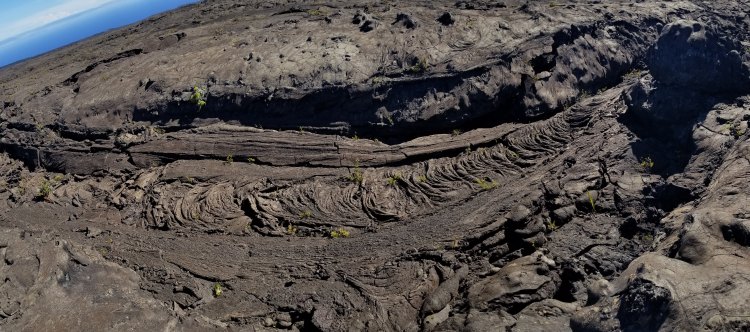
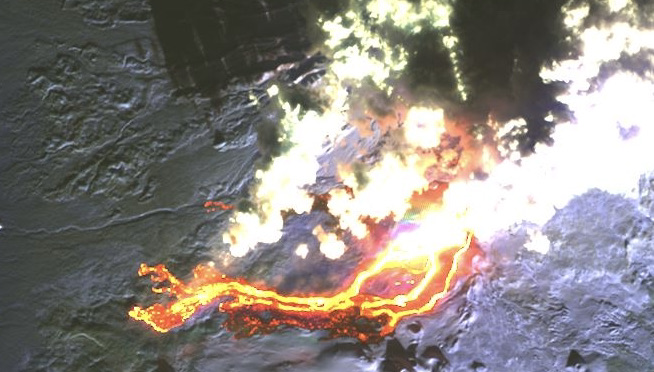
Earth: My research interests for terrestrial volcanism generally falls into two categories. (1) On Earth we have the ability to observe and quantify volcanic activity pre-, syn-, and post-eruption using a variety of satellite data, field campaigns, and laboratory methods. This allows us to develop an understanding of how volcanic features are emplaced on Earth. From this baseline we can extrapolate and compare terrestrial volcanism to that on other planets. How are volcanic landforms different/similar on Earth and other planets? What causes morphologic differences (if they exist)? Through detailed mapping (using visible, thermal and radar datasets) of volcanic features on Earth we can perform comparative planetology to similar features observed throughout the solar system. (2) Volcanism on Earth presents many hazards to local populations (e.g., pyroclastic density currents, lava flows, and lahars). Modeling these volcanic flows can help mitigate future disasters. A vital but often overlooked parameter when modeling a volcanic flow is the topography. How does the resolution of the topographic dataset impact the model, and will this impact future hazard predications/mitigation efforts? Accurately incorporating topographic data into a model is vital to fully assess modeling results.
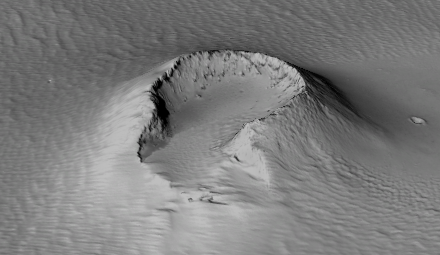
Mars: Volcanism is a critical component of how the Martian surface formed and evolved. Some of the most recent volcanic activity on Mars occurred in the southwestern Arsia Mons flow fields. Flows here, however, have complex overlapping relationships that conceal their full length and source vent. The lack of an origin point precludes any flow modeling that requires flow length and/or information about vents such as the channel/vent dimensions. The flows in this region thus present interesting volcanological questions that I aim to answer through detailed flow mapping and thermorheological modeling. Why are these relationships so common in this region on Mars but rarer on Earth? Are these flows generated from a common location (and therefore, during a singular eruptive event)? Do these relationships tell us anything about the underlying plumbing structure of Arsia Mons?
Venus: The surface of Venus is covered with volcanic features (numerous lava flow textures and morphologies, domes, and potential pyroclastic deposits). Several studies have pointed to evidence that volcanism may still be occurring across the Venusian surface. However, the effect of the environment (i.e., the high atmospheric pressure and temperature, and CO2 rich atmosphere) on the emplacement of lava flows is poorly understood. How do these environmental conditions affect the cooling rate and morphology of erupting lava flows? With multiple upcoming missions to Venus, and investigating volcanic activity a primary objective for VERITAS, it is important to answer this question if we hope to accurately interpret observed volcanic flows. Using thermorheological modeling and the development of improved heat loss models, I hope to understand how this extreme environment influences the emplacement of Venusian lava flows.
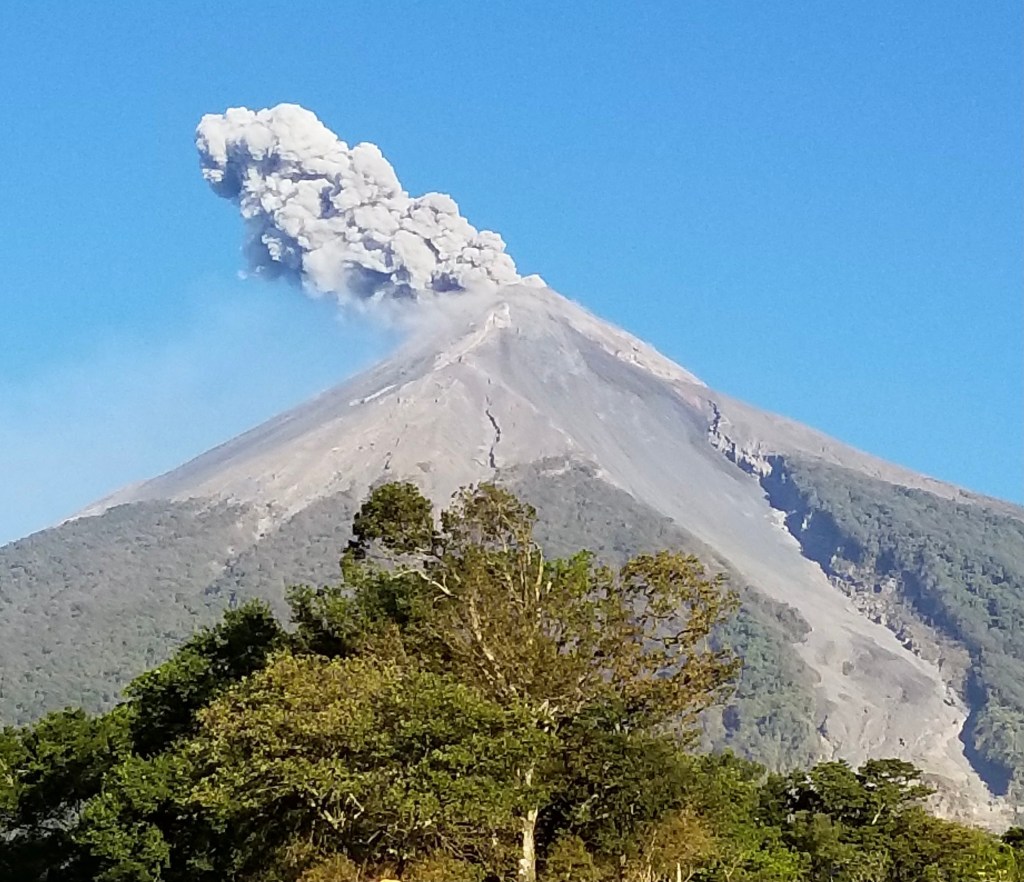
Photos by Ian Flynn.
 Ian T.W. Flynn